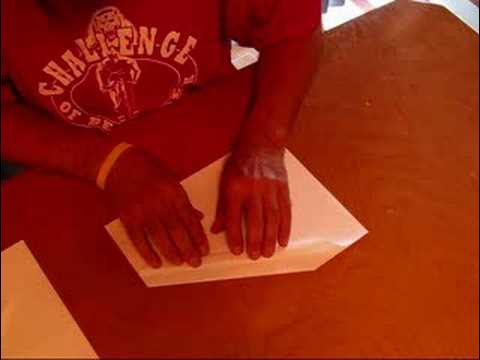
The OmniWing: a paper airplane that glides like a hang glider.
The OmniWing is a flying wing folded from one sheet of printer paper. Mike Kelsey designed it in 1973 to fly the way the hang gliders he flew did: a wide wing, a built-in twist, and a long, flat glide instead of a hard throw.
- Free instructions, with Mike's own videos
- One sheet of paper, tape, scissors
- About 15 minutes the first time
- Print-and-fold template: the folds, cuts and steps printed on the sheet
Three wings, one idea
Mike built them in this order and taught them in this order. Each one adds a technique the next one depends on.
Proto OmniWing Free
Folds, two strips of tape and a dime-sized nose weight. The easiest build and the best place to start, especially with kids.
Build the ProtoOmniWing Free
Same start, then a tapered leading edge, a taped-in twist, a keel and leading-edge covers. Flies straight off the table, no tuning.
Build the OmniWingAdvanced OmniWing Guide
Structural rolls, cross spars and double surfaces. Twice the wing loading: fast, long glides, and happy in wind and off hills.
See the guide
Mike Kelsey, 1973
Fresh out of high school, Mike started flying hang gliders the year the sport began. He wanted a paper model that flew the way those early gliders did, so he folded one: a wide, swept wing with a twin-cone sail shape instead of a schoolyard dart.
That crude model became the Proto OmniWing. Years of folding, cutting and taping turned it into the OmniWing, and then into Advanced OmniWings that beat balsa gliders in indoor competition. He has been building them ever since, and in 2008 he started filming how.
Never give up on a wing that doesn't fly. When you've failed at something, now is when the learning begins.Mike KelseyRead the story
Watch it fly
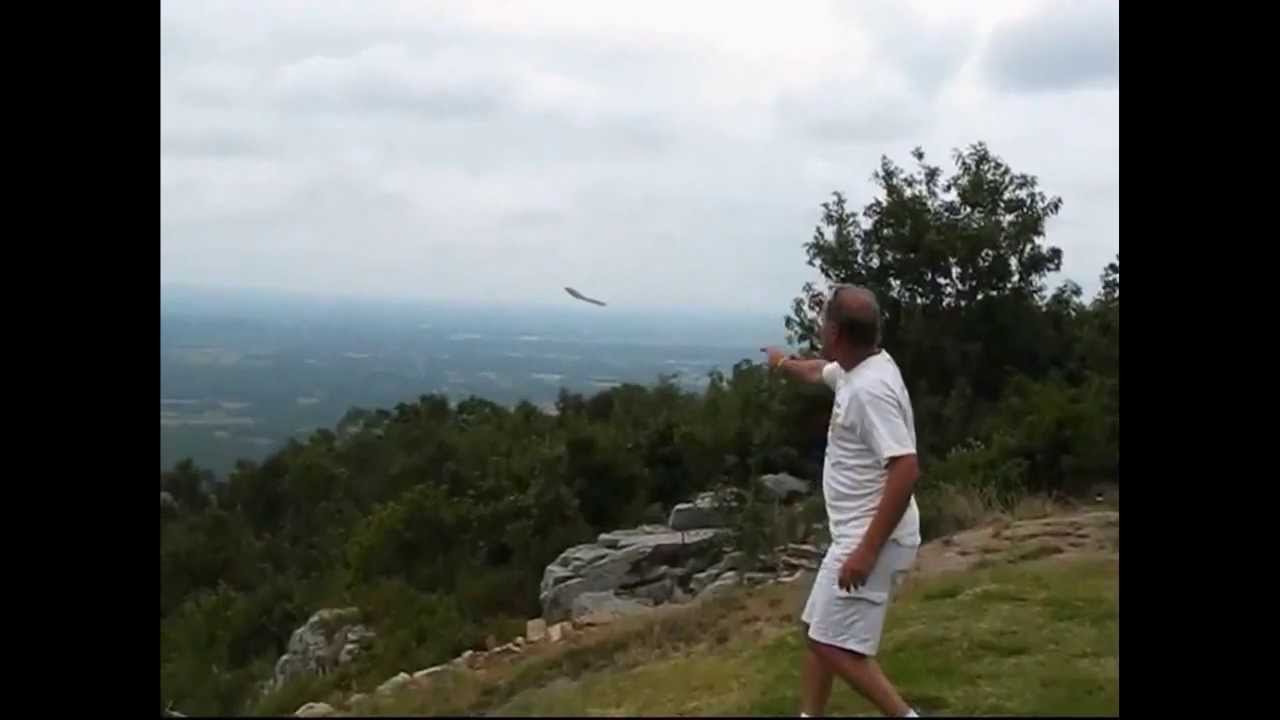
Mount Nebo State Park, Arkansas, 2012. Light wind straight into the launch, four pre-folded OmniWings and one Advanced, and fifty or sixty flights. Mike's goal for the day was either a wing that flew away and disappeared, or one that came back for the perfect catch.
If you love something, set it free. If it comes back... something like that.Mike, after the catch
Loads from YouTube when you press play.
Why a wing with no tail flies straight
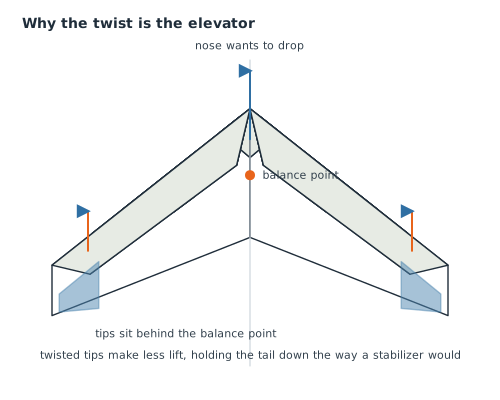
A flying wing has nothing behind it to hold the nose up. The OmniWing solves that the way a hang glider does: each wingtip is twisted a few degrees nose-down and taped in place. The tips sit behind the balance point, so they do the job of an elevator.
Get the twist in and the wing flies off the drawing board. Lose it, by pressing the wing flat while you tape, and it dives. Every step in the guide that touches the wing after the twist says the same thing: pick it up and follow the twist.
Aerodynamics, in Mike's wordsGo further: the Advanced OmniWing
Mike's structural techniques written up as one printable guide: the four-fold roll, leading-edge build-up, double surfaces, the two-sheet Advanced OmniWing in four parts, and the 26-inch wing. Illustrated the same way as the free guides, with his rules of thumb and his test-fly checkpoints.
See what's inside