The story of the OmniWing
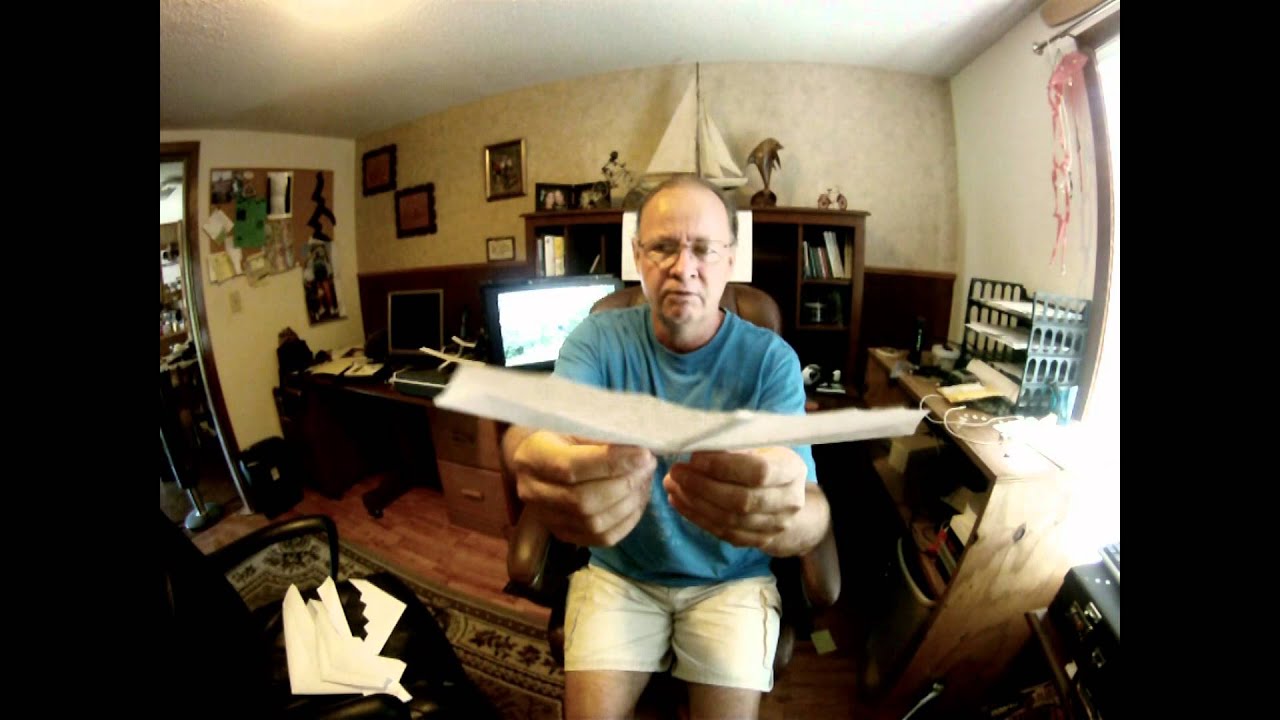
"My name is Mike Kelsey. I'm 58 years old, and yes, I still play with paper airplanes." That was 2011. He started in 1973, and he is still at it.
1973: a paper hang glider
Mike was out of high school and looking for something to do when he found hang gliding. The sport had only just begun. The gliders came straight out of factories and were still, in his words, fairly primitive in design and performance.
He wanted a scale model that would duplicate the flight of those gliders, so he could work out how and why they flew. The first one was crude, but it copied the twin conical sail shape of the early gliders and it performed. He kept at it: different folds, different construction, anything that made it fly better.
Eventually he arrived at the wing he now calls the OmniWing: the proportions of a modern hang glider, the same amount of twist, a center keel and supporting structure in the leading edge that gave it something like an airfoil, and a remarkable step up in performance over the first version, which became the Proto OmniWing.
Competitions, balsa and the Advanced wing
Once the OmniWing flew, Mike started experimenting with modifications and found there were basically unlimited ways to fold and change the platform. Some were for looks: the mid-70s hang gliders with battens and the "roach" cut to their sails, a B-2 bomber. Some were for performance.
The performance line became the Advanced OmniWing: two sheets of paper, a built-up leading edge, layered structure, and two hours of work for a competition wing. In the early 70s he flew them in indoor contests, including open classes where other people's entries were balsa wood. His paper wings beat them.
Some have taken the OmniWing and made modifications to the point where it's really now their own wing. They could name it after themselves, and they've come up with something original. That's what it's all about.Mike Kelsey
2008: the videos
In July 2008 Mike put the first OmniWing build on YouTube, under the name menamiketrx, filmed outdoors with a water fountain and a passing train on the soundtrack. He was never happy with it. The 2009 remake of "Building the OmniWing Paper Airplane", shot on a kitchen table in nine and a half minutes, has been watched more than five million times.
He kept going: the structural modifications in two parts, the Advanced OmniWing in four parts under the OmniArk Productions title card, an aerodynamics talk, flight days at Mount Nebo, the Proto remake he'd promised for years, and in 2014 a 26-inch wing cut from poster paper. He answered the comments, all of them. The videos were pointed at a website, omniwing.com, that has since lapsed. This site picks that up.
- 1973
Starts hang gliding; folds the first paper model of his glider, later the Proto OmniWing.
- 1970s
Years of refinement produce the OmniWing and the Advanced OmniWing. Indoor competition wins against balsa gliders.
- 2008
First build videos: the OmniWing modifications (Step 1 and Step 2) and the Advanced OmniWing Part 1.
- 2009
"Building the OmniWing Paper Airplane", the video that introduced the wing to millions.
- 2011
"The inspiration of the OmniWing" and "OmniWing Paper Airplane Aerodynamics".
- 2012
Advanced OmniWing Parts 2 to 4; flight day at Mount Nebo State Park, Arkansas.
- 2013
The Proto OmniWing, remade properly at last.
- 2014
A 26-inch high-aspect-ratio OmniWing in poster paper: "taking the flying wing concept to the extreme."
- 2026
TheOmniWing.com, built by his family to keep the designs and the teaching in one place.
How Mike teaches
I like to use other materials and other techniques to really achieve the best flying aircraft that I can.On tape and scissors
As with aircraft, it is an exacting science even though we're working with paper.On lining up edges
Don't just stick with the builds that I've shown you. Experiment.On what to do next
Never give up on a wing that doesn't fly. Try shaping and bending and twisting to try to get that thing to fly. When you've failed at something, now is when the learning begins.On failure
If it isn't flying at this point I'm not going to fool with it much longer, and I'll go on and try something else.On test flights mid-build
All in all, it's all for fun. So if you've got time, sit down and build one.On why