How the OmniWing flies
Mike has no formal training in aerodynamics. He has fifty years of hang gliding, ultralights and paper, which turns out to be enough. This page is his "aircraft design 101", lightly tidied, plus his tuning and launching habits.
A glider, not a projectile
The schoolyard dart and the record-setting distance planes are built for a hard throw: they climb in an arc on arm strength and settle into a short glide. Mike's wings are the opposite. They have a wide span for their size, so more of the paper is working as a wing, and they are launched at walking speed. They will never win a distance contest against a quarterback. They do something else: they glide.
| Aircraft | Glide ratio (distance per height lost) |
|---|---|
| Schoolyard dart | very little |
| OmniWing | good, and flat |
| High-performance hang glider | about 14 to 16 to 1 |
| Sailplane | 20 to 30 to 1 |
Mike's figures for the full-size aircraft. He has never measured the OmniWing's glide ratio formally; the Mount Nebo flights give you an idea.
Why there is no tail
A conventional airplane carries its people and engines up front, which makes it want to dive, and balances that with a stabilizer at the back set at a different angle from the wing. The fuselage, stabilizer and rudder all do a job, but none of them makes lift, and every surface dragging through the air costs something. Mike calls that parasitic drag. A flying wing, like a hang glider or the B-2, gets rid of all of it. Everything out there is wing.
The catch is stability. With no tail, something else has to keep the nose from dropping, and nothing on a paper airplane moves.
The twist is the elevator
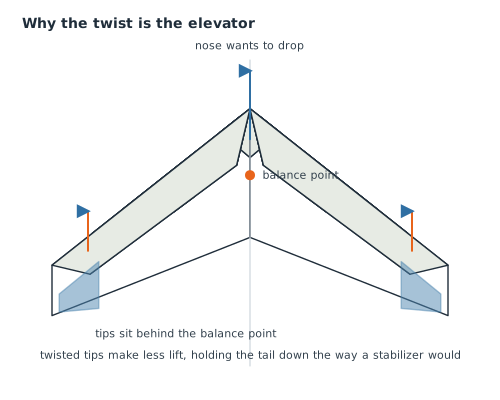
Look at the OmniWing from above. It is swept, so the wingtips sit well behind the balance point. In step 9 of the build each tip is twisted a few degrees nose-down and taped there, the same washout you see in a modern hang glider. Those tips make a little less lift than the center section. Because they are behind the balance point, that works exactly like a stabilizer: it holds the tail down and the nose up, balancing the weight Mike builds into the nose.
It also gives the wing its manners. If a launch goes wrong and the nose pops up, the wing stalls, the nose drops, it picks up speed and the twist levels it out again on its own. You can see it happen in the flight video.
Lose the twist and none of this works. That is why every step after the twist says: pick the wing up and follow the twist while you tape. Press it flat on the table and you have ironed out your elevator.
Tuning, Mike's way
There are no control surfaces, so you tune by bending, in small amounts, testing after each change.
- DivesAdd reflex: curl the trailing edge up a touch with a fingernail, especially out at the tips.
- StallsToo much reflex, or a light nose. Flatten the tips a little, or add tape to the nose.
- TurnsThe tips don't match. Raise the trailing edge slightly on the side it turns toward.
- Flies too fastA little more reflex across the trailing edge slows it and flattens the glide.
Launching
Hold the keel just behind the nose, keep the wing level, and release it gently into still air or a light headwind. Indoors, a hallway or gym. Outdoors, Mike's favorite is a hill: the northeast launch at Mount Nebo State Park in Arkansas, where the hang glider pilots fly, with a light wind coming straight up the slope. From there a wing can fly out over the bowl, turn a full circle in the lift and land back at his feet. "Just barely turning loose of the wing, and it just goes flying into the light breeze."
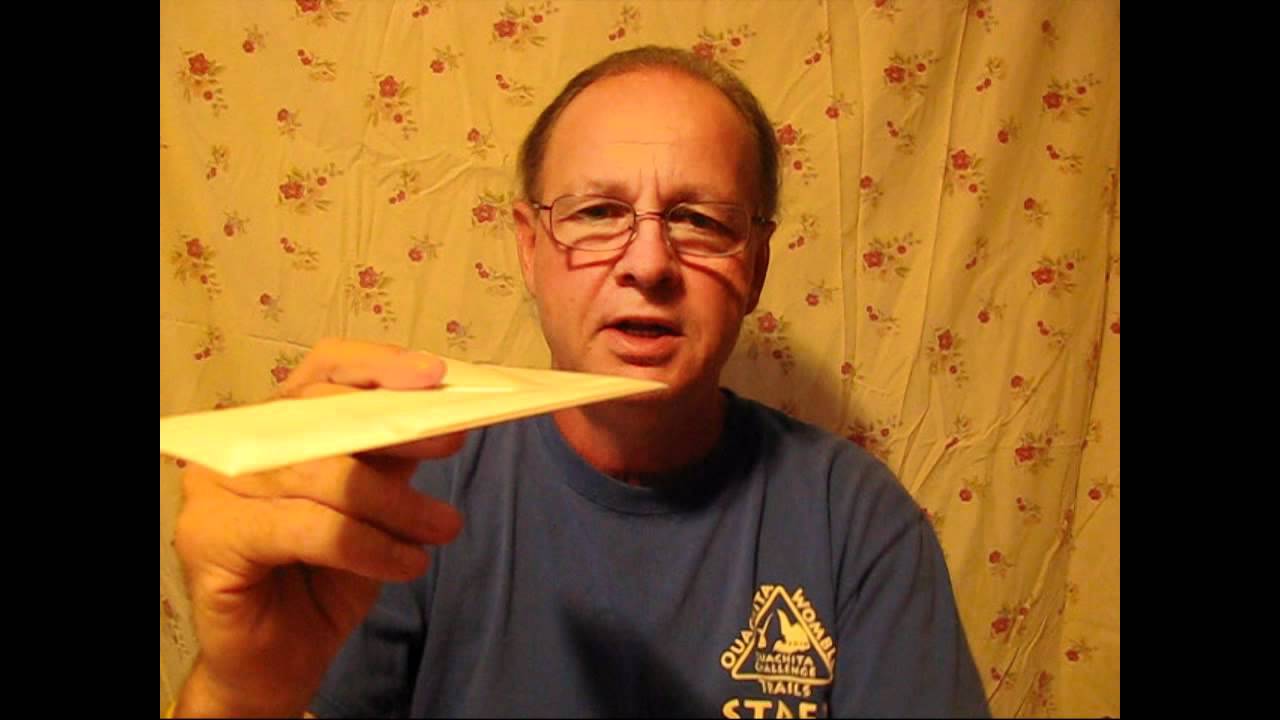
Mike's own explanation, with a conventional paper airplane built for the comparison. Loads from YouTube when you press play.
Heavier wings
The structural modifications and the Advanced OmniWing more than double the wing loading. A heavier wing flies faster, cuts through wind that would toss an OmniWing around, and glides further from a hill launch. The trade-off, in Mike's words: it's made of paper, it flies fast, and when it comes in contact with objects it can do damage to itself. Those techniques are written up in the Advanced guide.